Centre for Internet and Society: 18th Anniversary
Centre for Internet and Society
A Bouquet of Memories on the 18th Anniversary
An animated digital banner celebrating eighteen years of the Centre for Internet and Society, featuring a cyber-inspired falling binary code and network visual theme.
Centre for Internet and Society (CIS) is an Indian multidisciplinary research organisation headquartered in Bengaluru, Karnataka. On 4 July 2008, exactly eighteen years ago today, CIS was registered as a society under the Karnataka Societies Registration Act, 1960 (Karnataka Act 17 of 1960). The same date also appears on the organisation's Permanent Account Number (PAN) card as the date of registration.
Today, 4 July 2026, marks the eighteenth anniversary of the Centre for Internet and Society (CIS).
My name is Tito Dutta. I worked at the Centre for Internet and Society from early 2015 to mid-2022. To mark the organisation's eighteenth anniversary, I have attempted to collect eighteen memories about CIS. Some are my own memories, while others document interesting facts and moments from the organisation's history.
Invitation to the Reader
If you have been associated with CIS in any capacity — as a staff member, fellow, intern, volunteer, Board or Society member, collaborator, or visitor — I invite you to contribute one happy memory, anecdote, photograph, or experience from your time at or around CIS.
You may share your contribution directly with Sunil Abraham or me (Tito Dutta), or email it to [email protected]. With your permission, it will be published here with proper attribution, so that together we can build a bouquet of memories celebrating eighteen years of the Centre for Internet and Society.
Note: This is a personal memoir and community memory project. It is not an official history of the Centre for Internet and Society, does not represent the views or positions of the organisation, and should not be read as an official publication. It also does not represent an official position of The Sunil Abraham Project (TSAP). Any opinions expressed here are entirely personal.
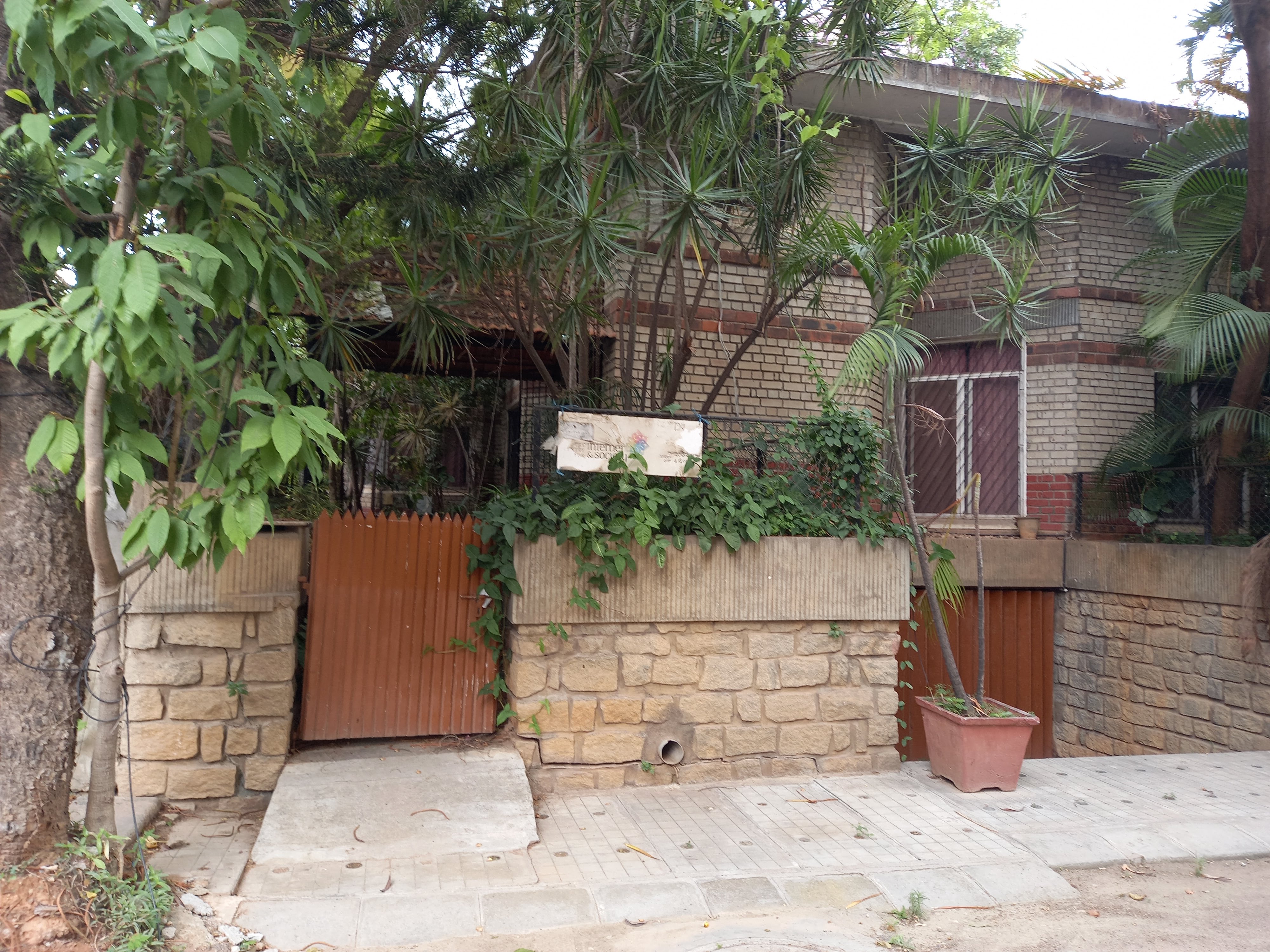
The Centre for Internet and Society office at Domlur, Bengaluru, which served as the organisation's headquarters for many years.
Contents
- The Name “Centre for Internet and Society”
- Domain
- The Telephone in the Lobby
- When CIS Opened Up Their Book of Accounts
- #PlayingAtCIS
- Velankanni Royson — Cake-cutting Expert
- Three Questions You Are Supposed to Answer
- Appreciation
- CIS Has Many Positions
- The Sub-$100 Mobile Phone
- First Bitcoin Community Meeting in India
- Society Members Throughout the Journey
- 13–18
1. The Name “Centre for Internet and Society”
William Shakespeare wrote, “What’s in a name?” Let us begin with the name itself. Why was the organisation named the “Centre for Internet and Society”? Why not something else, such as “India’s Internet Watchers”?
As far as I know, in 2008, when the idea of establishing the organisation was taking shape, a concept note was prepared. At that time, a few inspirations were the Berkman Center for Internet & Society, the Stanford Center for Internet and Society, and the Nexa Center for Internet & Society. These inspirations were directly reflected in the name. As this initiative was based in India, the domain name became cis-india.org.
Sunil Abraham recalled how CIS got its name in a 2012 talk. You may watch the relevant portion of the video here.
2. Domain
When checking some websites, I have a habit of looking at their domain registration and DNS records. Naturally, I have done the same for the CIS domain over the years. Here are some details that are already publicly available.
The domain cis-india.org was registered on 16 June 2008, eighteen days before the formal registration of the Society. Based on the publicly available WhoIs record, the domain was most likely registered by Pranesh Prakash. The contact address listed in the WhoIs record continues to be 194, 2nd C Cross, Domlur 2nd Stage, Bangalore, Karnataka 560071.
The domain was last updated on 19 June 2019, when it was renewed for ten years. Personally, I like this approach. If an organisation can afford it, renewing a domain for five or ten years at a time helps ensure that it remains active even in unforeseen circumstances. CIS adopted this approach. At the time of the renewal in June 2019, Sunil Abraham was the Executive Director of CIS.
3. The Telephone in the Lobby
If you have ever visited the CIS office at Domlur, Bengaluru, you might have noticed an old telephone in the lobby, just beside the kitchen door. I do not have a photograph of it with me now. If you do, please share it with me.
It was a classic rotary telephone with a circular numbered dial and a handset receiver.
Many visitors may have wondered why an old telephone was placed in the office of an internet research organisation, where everyone used mobile phones and other modern devices.
As far as I know, the telephone symbolised that the work of CIS was not limited to the Internet alone, but extended to Information and Communication Technologies (ICT) more broadly.
4. When CIS Opened Up Their Book of Accounts
Did you know that CIS once opened up its financial records and books of accounts for public scrutiny? It did so in May 2013, when the organisation was celebrating its fifth anniversary.
As part of the celebrations, CIS organised an exhibition showcasing five years of research, advocacy, and publications, along with four evenings of talks, film screenings, and classical music performances in Bengaluru. At the same time, it opened its financial records for public scrutiny, disclosing how donor funds had been spent over the course of its existence.
According to Sunil Abraham, the decision was partly influenced by the wider public debate around the Foreign Contribution Regulation Act (FCRA), 2010, and the increasing scrutiny of NGOs receiving foreign contributions. Opening the organisation’s books of accounts was intended to demonstrate transparency and accountability.
On TSAP, we have a separate article on the fifth anniversary of the Centre for Internet and Society, which you may read here.
Carnatic music performance by Nirmita Narasimhan, then a CIS member, during the fifth anniversary celebrations of the Centre for Internet and Society on 23 May 2013.
5. #PlayingAtCIS
In September 2016, a brief informal ritual called #PlayingAtCIS started at the CIS office.
The idea was simple. Whenever a song was played aloud in the office, anyone on Twitter could post the song title and artist, if known, using the hashtag #PlayingAtCIS. Over time, this would create a timeline of the music played at the office.
Only songs played aloud in the office, and not those heard individually on personal devices, were meant to be shared using the hashtag.
Most of the shared songs were never compiled into a single list, and some of the posts may have been lost over time. However, you can still find some old posts using the hashtag here.
6. Velankanni Royson — Cake-cutting Expert
Velankanni Royson, or simply Royson, as we used to call him, worked in the administration department. Being one of the first staff members of CIS, he had been associated with the organisation from its very beginning. I could find his name in the very first annual report of CIS (2008–2009). Here, however, I will speak only about his cake-cutting expertise.
CIS had a simple tradition of cutting cakes on two occasions: when someone joined the organisation, and on a staff member’s birthday. These celebrations usually took place during office hours, mostly in the afternoon, and lasted about 10–15 minutes. The birthday person or the new colleague would briefly speak about themselves or their upcoming work, followed by a short interaction with other members.
Then came the cake-cutting. Almost none of us were efficient enough to cut a large cake into a dozen or more equal pieces in under a minute. So, the person being celebrated would make the ceremonial first cut, after which Royson would take over. Within no time, he would neatly cut the entire cake into almost perfectly equal pieces.
Royson, being one of the first staff members of CIS, made many important contributions to the organisation. On a lighter note, he was also the office’s cake-cutting expert.
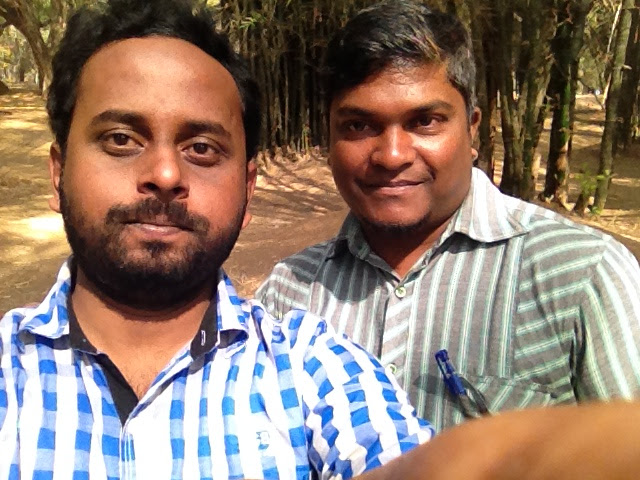
Velankanni Royson (right) and me (Tito Dutta, left, taking the selfie), Bengaluru, 2017.
7. Three Questions You Are Supposed to Answer
As I just talked about the CIS cake-cutting ceremony, let me mention a related ritual that used to take place during the welcome meeting for new members.
When someone joined CIS, they were usually asked to answer three questions, apart from introducing themselves. As far as I remember, the questions were:
- What is the meaning of your name?
- What work have you done so far? (For freshers, this usually meant their studies.)
- Tell us an interesting fact about yourself.
Note: As far as I remember, these were the three questions. However, there is a possibility that I am slightly mistaken about one of them. It has been more than six years since I last attended such a welcome meeting, and my memory may not be perfect. If you remember them differently, please let me know so that I can correct this list.

Sunil Abraham cutting a birthday cake with colleagues at the Centre for Internet and Society, Bengaluru, 2017.
8. Appreciation
There used to be a ritual at CIS, more like an icebreaker before some meetings. Sunil used this activity quite often. It was called “Appreciation”.
Before the meeting began, if there was some time, Sunil would ask everyone to participate. One person would be chosen at random, and the others would say something they admired or appreciated about that person. The only rule was that everyone had to share something positive.
I participated in this activity a few times. Looking back after all these years, I feel it was a wonderful team-building exercise. We do not always take the time to appreciate the work or qualities of others. Activities like this encouraged people to express kindness and appreciation openly.
9. CIS Has Many Positions
What was, or what is, CIS’s position on various internet governance, public policy, and even geopolitical issues? Whenever this question came up, we used to clarify that CIS did not have one position, but many positions.
As Sunil Abraham said in a 2018 interview with FactorDaily: “People would ask what’s the CIS position on net neutrality. And the answer to that question is always the same — CIS is like the Kamasutra, we don’t have one position. We’re a collection of many positions.”
I used to explain the same idea using the example of a football team. A football team has many positions: goalkeepers, defenders, midfielders, and forwards. Similarly, the Centre for Internet and Society had many positions.
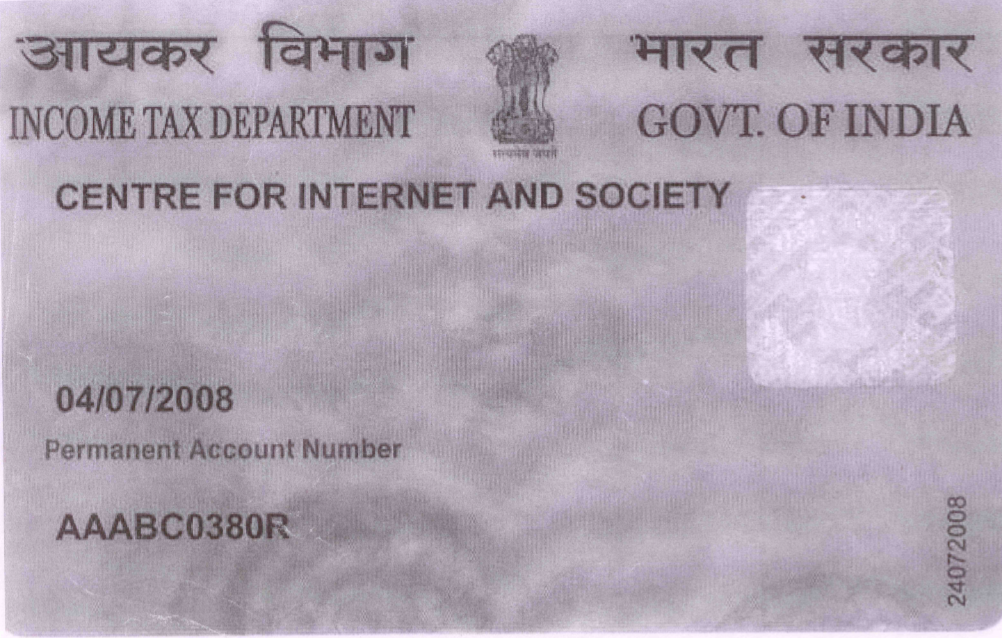
Permanent Account Number (PAN) card of the Centre for Internet and Society. The card bears PAN AAABC0380R and records 4 July 2008 as the organisation's date of registration.
10. The Sub-$100 Mobile Phone
In 2014, one of the research projects at CIS under the Access to Knowledge programme focused on the “Pervasive Technologies: Access to Knowledge in the Marketplace” project.
The project sought to identify policy measures that could help ensure access to sub-$100 networked mobile phones in India and China. The research covered not only mobile phone hardware, but also software, such as mobile applications, and digital content, such as music and media. Much of the work examined patent and copyright law in the context of access to affordable communication technologies.
Several reports and working papers were published as part of this project, documenting different aspects of intellectual property, competition law, patent landscaping, mobile applications, and access to knowledge.
At that time, US$100 was approximately ₹6,300–6,400. Interestingly, Sunil Abraham himself used a sub-$100 mobile phone as his personal device for many years.
11. First Bitcoin Community Meeting in India
According to CIS records, the first Bitcoin community meeting in India was held at the CIS office in Bengaluru. This took place before I joined the organisation, so I have relied on publicly available CIS documents.
There is, however, some uncertainty regarding the exact event and date. A CIS bulletin (January 2013) mentions “An Introduction to Bitfilm and Bitcoin – A Discussion” by Aaron Koenig, Managing Director of Bitfilm Networks, Hamburg, Germany, held at the CIS office on 23 January 2013. However, the CIS Annual Report 2013–2014 mentions a meeting on “Bitcoin & Open Source” with Aaron Koenig at the CIS office on 7 February 2014.
At present, I have not been able to locate a detailed report of the event. As TSAP continues documenting the history of CIS, this is one topic that deserves further research. If you have any photographs, notes, announcements, or other documentation relating to these meetings, please feel free to share them.
One more interesting fact. In early 2013, when CIS conducted this Bitcoin-related event, one Bitcoin was worth only about US$14 (around ₹800). Today, on 4 July 2026, one Bitcoin is worth around US$62,000 (about ₹59 lakh). Ouch! One cannot help but wonder whether anyone involved with organising the event bought Bitcoin worth ₹5,000 or ₹10,000 back then.
Either way, I find it remarkable that CIS was organising Bitcoin-related events at such an early stage in the technology’s history.
12. Society Members Throughout the Journey
According to the official lists of the CIS Society and Board members published by CIS, two individuals have remained associated with the organisation throughout its entire journey from 2008–09 to 2023–24: Sunil Abraham and Prof. Subbiah Arunachalam.
Several other individuals also had long associations of ten years or more with the CIS Society or Board. These include Vibodh Parthasarathi (14 years), Lawrence Liang (10 years), T. Vishnu Vardhan (10 years), Pranesh Prakash (10 years), and Shyam Ponnappa (10 years).
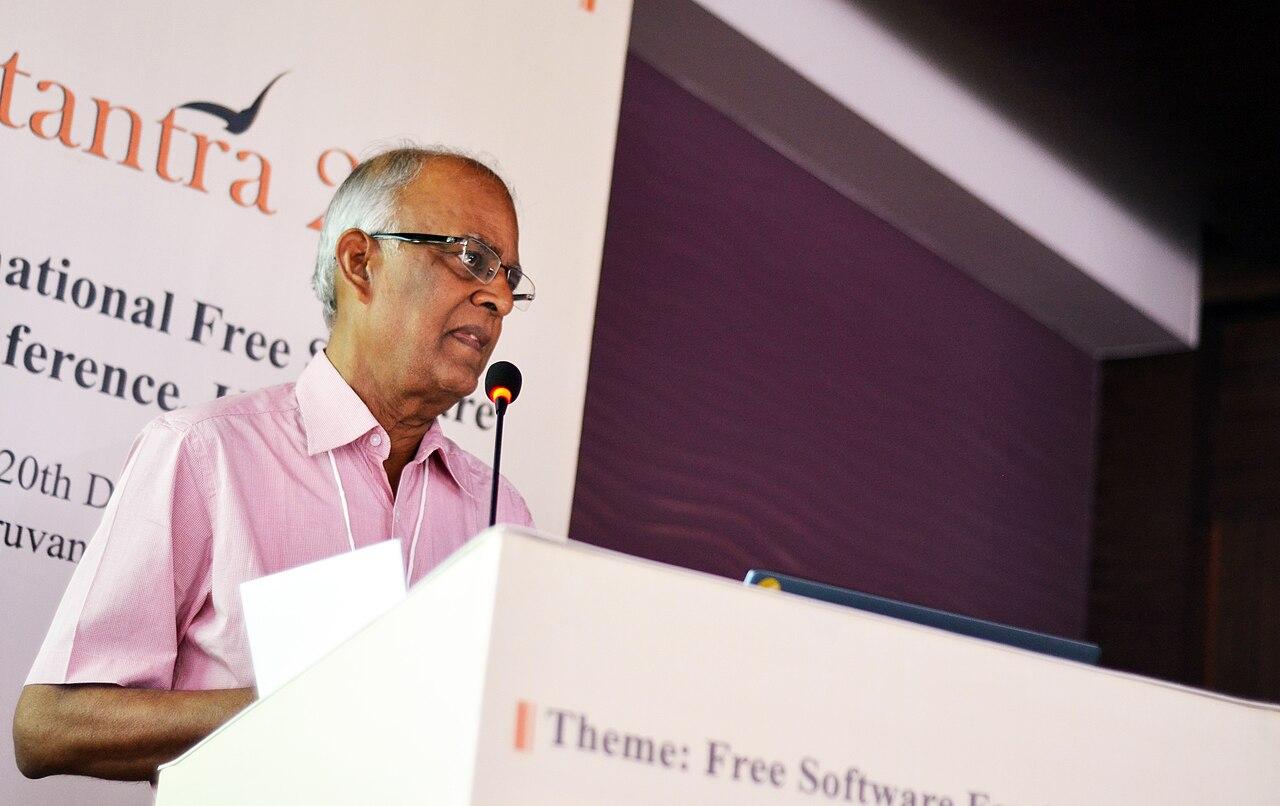
Prof. Subbiah Arunachalam at Swatantra 2014, an international free software conference held in Thiruvananthapuram, Kerala, in late 2014. Image source: Wikimedia Commons. Shared under the Creative Commons Attribution-ShareAlike 4.0 International (CC BY-SA 4.0) licence.

13–18
The remaining six memories are intentionally left blank for now.
I hope to add them during the first couple of weeks of July 2026. Some may be my own memories, while others may come from people who have been associated with CIS over the years.
If you have a happy memory, anecdote, photograph, or experience related to the Centre for Internet and Society, I invite you to contribute it as described in the invitation above. With your permission, it will be published here with proper attribution as part of this growing bouquet of memories celebrating eighteen years of CIS.
Authenticity: This memoir was cryptographically signed by Tito Dutta on 4 July 2026 using OpenPGP. The detached signature is available as 18.md.asc in the TSAP source repository.
Information about the signing key, verification process, and the register of signed documents is available in the TSAP Cryptographic Signing and Verification Policy.
📄 This page was created on 4 July 2026. You can view its history on GitHub, preview the fileTip: Press Alt+Shift+G, or inspect the . Last updated on 4 July 2026.