Fifth Anniversary of the Centre for Internet and Society
The Fifth Anniversary of the Centre for Internet and Society was a four-day public celebration held from 20 to 23 May 2013 at CIS offices in Bangalore and Delhi, marking five years since the organisation’s founding on 4 July 2008. The event comprised an open exhibition showcasing five years of CIS’s research, advocacy, and publications, alongside four evenings of talks, film screenings, and classical music performances in Bangalore. Sunil Abraham, who was Executive Director of CIS at the time, was quoted in contemporaneous coverage in the run-up to the event, reflecting on the evolution of internet policy debates in India over the preceding five years. In a gesture of organisational transparency, CIS threw open its financial records to public scrutiny, disclosing how it had spent the ₹13.13 crore received from donors over the course of its existence.
Contents
- Background
- Exhibition
- Evening Programmes
- Speakers
- Artists
- Locations
- Press Coverage
- Event Flier
- References
- External Links
Background
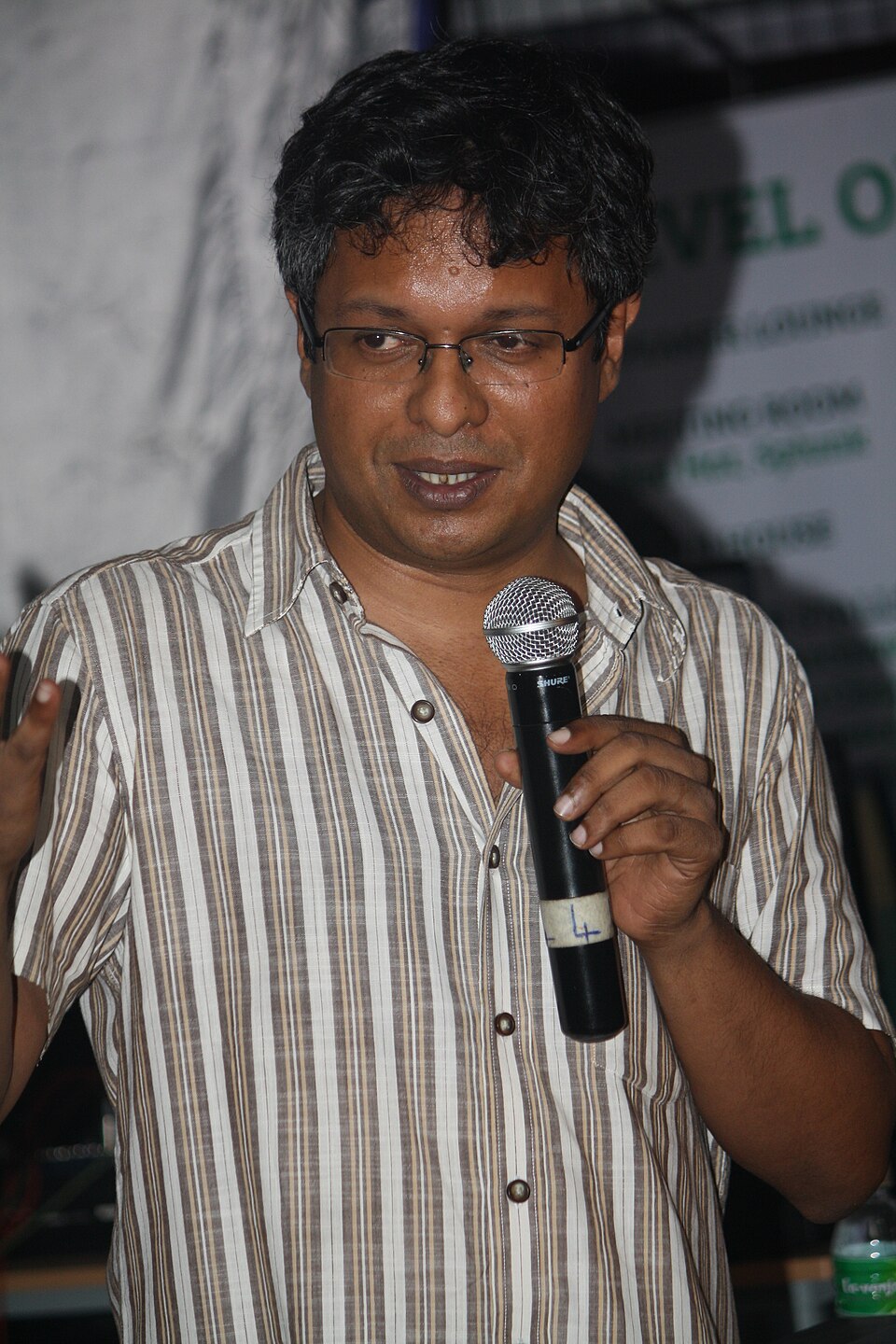
Sunil Abraham speaking during the fifth anniversary celebrations of the Centre for Internet and Society in May 2013.
Source:
Wikimedia Commons
.
Licensed under the Creative Commons Attribution-Share Alike 3.0 Unported license.

The Centre for Internet and Society was registered on 4 July 2008 and, by May 2013, had grown into one of India’s leading internet policy research organisations. In an interview published on the eve of the celebrations, Sunil Abraham noted the shift in public awareness over those five years: privacy had moved from a niche concern to a mainstream policy debate, the problematic provisions of the Information Technology Act had gained wider recognition, and shared spectrum, once dismissed as a pipe dream, had found its way into the National Telecom Policy. The anniversary programme was conceived to reflect this breadth: rather than a narrowly technical event, it placed internet issues within the wider ecology of television, cinema, language, and culture.
CIS marked the occasion with an act of transparency that set the celebrations apart from a conventional institutional milestone. The organisation opened its account books and donor contracts to the general public, inviting visitors to examine how the ₹13.13 crore it had received from donors had been spent. Sunil Abraham described the initiative in a press statement as “getting the general public to be our auditors by throwing open our account books and contracts.” The Udayavani report of 25 May 2013 noted this aspect of the event approvingly, describing the organisation’s effort to engage the public directly and underlining the transparency as a defining feature of the celebration.
At the time of the anniversary, CIS had seventeen staff members, four based in Delhi and the remainder in Bangalore, alongside seven distinguished fellows and five fellows. The organisation had received funding from seventeen donors, a majority from overseas, with primary funders including the Kusuma Trust, the Wikimedia Foundation, and the Hans Foundation. Sunil Abraham noted that the decision to open the accounts was partly motivated by the climate of scrutiny surrounding NGOs at the time, particularly following parliamentary debates on the Foreign Contribution Regulation Act (FCRA) of 2010, which had drawn attention to financial transparency practices among organisations receiving overseas contributions.
Exhibition
The open exhibition ran on all four days from 20 to 23 May 2013, from 10.00 a.m. to 8.00 p.m., at both the Bangalore and Delhi offices of CIS. The exhibition was accompanied by printed material and posters detailing individual projects and thematic areas. Thematic areas covered in the exhibition included accessibility, access to knowledge, openness, internet governance (free speech and privacy), telecom, RAW monographs in digital humanities, and organisational materials such as media coverage and an organisational chart. All exhibition posters were subsequently made available for public download from the CIS website.
By the time of the anniversary, CIS had produced 641 research items over five years, comprising essays, books, and blog entries across its programme areas. The organisation had also conducted research on the accessibility of India’s e-governance systems, producing recommendations on making digital public services more accessible to persons with disabilities.
Four artists — Kiran Subbaiah, Tara Kelton, Navin Thomas, and Abhishek Hazra — exhibited their work and gave live demonstrations during the exhibition. Attendee Nigel Babu, writing on his personal blog on 23 May 2013, noted Tara Kelton’s work and the work of Sharath Chandra Ram among those that stood out to him. Kelton presented Trace, a surveillance camera feed drawn in real-time by anonymous online workers, while Kiran Subbaiah presented Spectator, a robot designed to sense the presence of human beings and respond to them as objects of observation.
Evening Programmes
The evening programmes were held exclusively at the Bangalore office. Each evening began at 6.00 p.m. and concluded with dinner. RSVP for all evenings was coordinated by Bernadette Längle and Prasad Krishna.
20 May 2013: Digitalisation and Rural Internet
The first evening opened with a talk by Vibodh Parthasarathi, Board Member at CIS and faculty at the Centre for Culture, Media and Governance, Jamia Millia Islamia, New Delhi. His talk, “Why did I buy a set-top box?: What we know, don’t know and need to know about Digitalisation” (6.00–7.00 p.m.), examined the rationale for the mandatory migration to digital cable, its implications for what viewers watch and pay for, and the less-discussed proposed digital switchover of the public broadcaster. The talk drew on his Country Report on the Media in India, produced as part of the Open Society Foundations’ global Mapping Digital Media initiative across 50 countries.
This was followed from 7.00 to 7.30 p.m. by a film screening on cyber cafes of rural India, presented by Kamini Menon and Christy Raj of Video Volunteers, a community media organisation that had been documenting rural internet access in partnership with CIS. Seven two-minute films were screened, each made by a community correspondent from a different Indian state: Achungmei Kamei (Manipur), Christy Raj (Karnataka), Meribeni Kikon (Nagaland), Avdhesh Negi (Himachal Pradesh), Saroj Paraste (Madhya Pradesh), Rohini Pawar (Maharashtra), and Neeru Rathod (Gujarat). The evening closed with a Hindustani classical vocal performance by Aditya Dipankar (7.30–8.00 p.m.).
21 May 2013: Cinema and the Internet
The second evening began with a screening of Sabaka (6.00–7.00 p.m.), a 1954 film directed by Frank Ferrin and starring Boris Karloff, Reginald Denny, and June Foray. This was followed from 7.00 to 8.00 p.m. by a talk by Lawrence Liang, Chairman of the Board at CIS, titled “Slouching towards Tlön: An Encyclopedia for the 2nd century of Indian cinema”. Liang reflected on Ashish Rajadhyaksha and Paul Willemen’s Encyclopedia of Indian Cinema (1994) and presented his work on an online collaborative version incorporating moving images, photographs, and archival materials. The talk raised questions about what an online film encyclopedia for the 21st century could look like, and the copyright and legal constraints that limit the use of archival material on the internet. Attendee Nigel Babu described it as “a very interesting talk,” noting its convergence of open data, open source software, and copyright issues.
22 May 2013: Cybersecurity, Privacy and Surveillance
The third evening was themed around cybersecurity, privacy, and surveillance, reflecting one of CIS’s core research areas. Maria Xynou, Policy Associate on the Privacy Project at CIS, opened with a talk titled “The Indian Surveillance State” (6.00–6.30 p.m.), presenting findings described in the programme as part of an investigation into surveillance technology companies operating in India. She reported that 76 companies had been identified as producing and selling surveillance equipment to Indian law enforcement agencies, set against the backdrop of the Central Monitoring System having become operational the previous month.
Bernadette Längle (6.30–7.00 p.m.) followed with a talk titled “Why Privacy and How?”, addressing the common assumption that those with “nothing to hide” need not worry about privacy, and demonstrating practical tools for protecting digital communications. Laird Brown and Purba Sarkar (7.00–7.45 p.m.) then presented a preview of a film project on cybersecurity in India, developed by CIS in cooperation with the Citizen Lab at the Munk School of Global Affairs, University of Toronto. The evening concluded with a hands-on demonstration by Längle on “Faking of Fingerprints” (7.45–8.00 p.m.), in which participants could replicate a fingerprint themselves.
23 May 2013: Kannada Language and IT
The final evening was dedicated to the Kannada language and its relationship with information technology. Dr. Chandrashekhara Kambara, Jnanpith Award laureate, poet, playwright, folklorist, film director, and founder-Vice-Chancellor of Kannada University, Hampi, delivered a guest lecture on “Kannada in the Modern Era” (6.00–6.15 p.m.). Dr. U.B. Pavanaja, former scientist at the Bhabha Atomic Research Centre and a pioneer in Kannada computing, then delivered the main talk (6.15–7.30 p.m.) titled “From Palm Leaf to Tablet: Journey of Kannada”, tracing the 2,000-year history of Kannada literature from palm-leaf manuscripts to tablets and smartphones, and the work done to implement Kannada across all facets of information technology. The talk was delivered with a Kannada-language summary. The evening concluded with a Carnatic music performance by Nirmita Narasimhan, Policy Director at CIS, who holds a doctorate in music from Delhi University and has been performing since 1995 (7.30–8.00 p.m.).
Speakers
| Speaker | Affiliation | Topic |
|---|---|---|
| Vibodh Parthasarathi | Centre for Culture, Media and Governance, Jamia Millia Islamia; Board Member, CIS | Digitalisation of television in India |
| Lawrence Liang | Chairman of the Board, CIS | Online encyclopedia of Indian cinema |
| Maria Xynou | Policy Associate (Privacy Project), CIS | Surveillance technology companies in India |
| Bernadette Längle | CIS; associated with the Chaos Computer Club | Digital privacy tools |
| Laird Brown and Purba Sarkar | CIS / Citizen Lab collaboration | Cybersecurity film project preview |
| Dr. Chandrashekhara Kambara | Kannada University, Hampi (founder-VC) | Kannada in the modern era |
| Dr. U.B. Pavanaja | Independent researcher, Kannada computing | History of Kannada in information technology |
Artists
Four visual and multimedia artists participated in the exhibition, each presenting work that engaged with themes of technology, surveillance, and culture:
- Kiran Subbaiah presented Spectator, a robot designed to sense the presence of human beings and respond to them as objects of observation. Subbaiah studied sculpture at Santiniketan, MSU Baroda, and the Royal College of Art, London, and was an artist-in-residence at the Rijksakademie, Amsterdam.
- Tara Kelton presented Trace, a surveillance camera feed drawn in real-time by anonymous online workers. Kelton holds an MFA from the Yale School of Art and has exhibited at GALLERYSKE (Bangalore), Vox Populi (USA), and the India Design Forum (Mumbai).
- Navin Thomas is a multimedia artist working with found objects and cultural artefacts.
- Abhishek Hazra presented #cloudrumble56, a performance re-animating transcripts of scientist M.N. Saha’s (1893–1956) interventions in the Indian parliamentary archives, transmitted through live tweets on Twitter. Hazra has exhibited at venues including the Science Gallery, Dublin, and Kunstmuseum Bern.
Two musicians performed during the evening programmes:
- Aditya Dipankar, Hindustani classical vocalist trained under Pandit Vijay Sardeshmukh, a senior disciple of Pandit Kumar Gandharva. He performed on 20 May 2013.
- Nirmita Narasimhan, Carnatic musician and then Policy Director at CIS, disciple of Dr. Radha Venkatachalam and Prof. T.R. Subramanyam. She was awarded the National Award for Empowerment of Persons with Disabilities by the President of India. She performed on 23 May 2013.
Locations
The exhibition was held simultaneously at two CIS offices.
Bangalore Centre for Internet and Society No. 194, Second ‘C’ Cross, Domlur, 2nd Stage Bangalore – 560071, Karnataka, India Ph: +91 80 4092 6283
Delhi Centre for Internet and Society G 15, Top Floor, Behind Hauz Khas, G Block Market Hauz Khas, New Delhi – 110016 Ph: +91 011 40503285
The evening programmes were held exclusively at the Bangalore office.
Press Coverage
The event received press coverage in both English and Kannada media:
- Subir Ghosh, writing in DNA India on 19 May 2013, published “A Lifetime of Five Years on the Internet”, drawing extensively on quotes from Sunil Abraham on the evolution of internet policy in India, covering privacy legislation, the IT Act, shared spectrum, broadband access, and patent and copyright policy.
- The Hindu published a report on 22 May 2013 titled “CIS Highlights Changes Ushered in by the Internet”, covering the ongoing exhibition and the remaining programme of talks, including the forthcoming evening on cybersecurity and the valedictory on Kannada and information technology.
- Udayavani, the Kannada daily, published a report on 25 May 2013 covering the event, with a headline referring to the importance of Kannada in computing contexts. The report noted CIS’s act of financial transparency and highlighted the organisation’s engagement with issues at the intersection of technology and society.
- Bangalore Mirror published a report on 18 May 2013 titled “NGO Invites Public to Peruse Its Accounts”, covering CIS’s decision to open its books of accounts to public scrutiny ahead of the anniversary, with quotes from Sunil Abraham on the transparency initiative
- Nigel Babu, a technology community member, wrote about attending the event on his personal blog on 23 May 2013, recounting the exhibition and Lawrence Liang’s talk on the encyclopedia of Indian cinema.
- The Hindu Business Line published a preview report on 5 May 2013 ahead of the anniversary celebrations, noting the planned exhibition at both Bangalore and Delhi offices and quoting Sunil Abraham on the decision to open CIS’s account books and donor contracts to the public.
Event Flier
If the PDF viewer does not load properly, please refresh the page or download the file directly.
References
- “Celebrating 5 Years of CIS”, Centre for Internet and Society, retrieved 7 May 2026
- Subir Ghosh, “A Lifetime of Five Years on the Internet”, DNA India, 19 May 2013, retrieved 7 May 2026
- Nigel Babu, “CIS Anniversary and Encyclopedia of Indian Cinema”, nigelb.me, 23 May 2013, retrieved 7 May 2026
- CIS Anniversary Emailer / Programme Brochure, Centre for Internet and Society, May 2013
- “ಕನ್ನಡಕ್ಕೆ ಅಂತರ್ಜಾಲದಲ್ಲಿ ಸ್ಥಾನ ಕಲ್ಪಿಸಿ” (Kannada), Udayavani, 25 May 2013
- “NGO Invites Public to Peruse Its Accounts”, Bangalore Mirror, 18 May 2013, retrieved 7 May 2026
- “CIS Anniversary”, The Hindu Business Line, 5 May 2013, retrieved 7 May 2026
- “CIS Highlights Changes Ushered in by the Internet”, The Hindu, 22 May 2013, retrieved 7 May 2026
External Links
- Official event page at CIS website
- Event photos at Wikimedia Commons
📄 This page was created on 7 May 2026. You can view its history on GitHub, preview the fileTip: Press Alt+Shift+G, or inspect the . Last updated on 1 August 2026.