Piracy Boils Down to Convenience
“Piracy Boils Down to Convenience” is a DNA India feature published on 16 August 2009. The piece brings together three voices on either side of the piracy debate, with Sunil Abraham, then Executive Director of the Centre for Internet and Society, arguing that commercial piracy is rooted in economics rather than convenience, and calling for collaboration between copyright owners, consumers, and technology rather than enforcement alone.
Contents
Article Details
- 📰 Published in:
- DNA India
- 📅 Date:
- 16 August 2009
- 📄 Type:
- De-bait Feature
- 📰 Newspaper Link:
- Not available online
Full Text
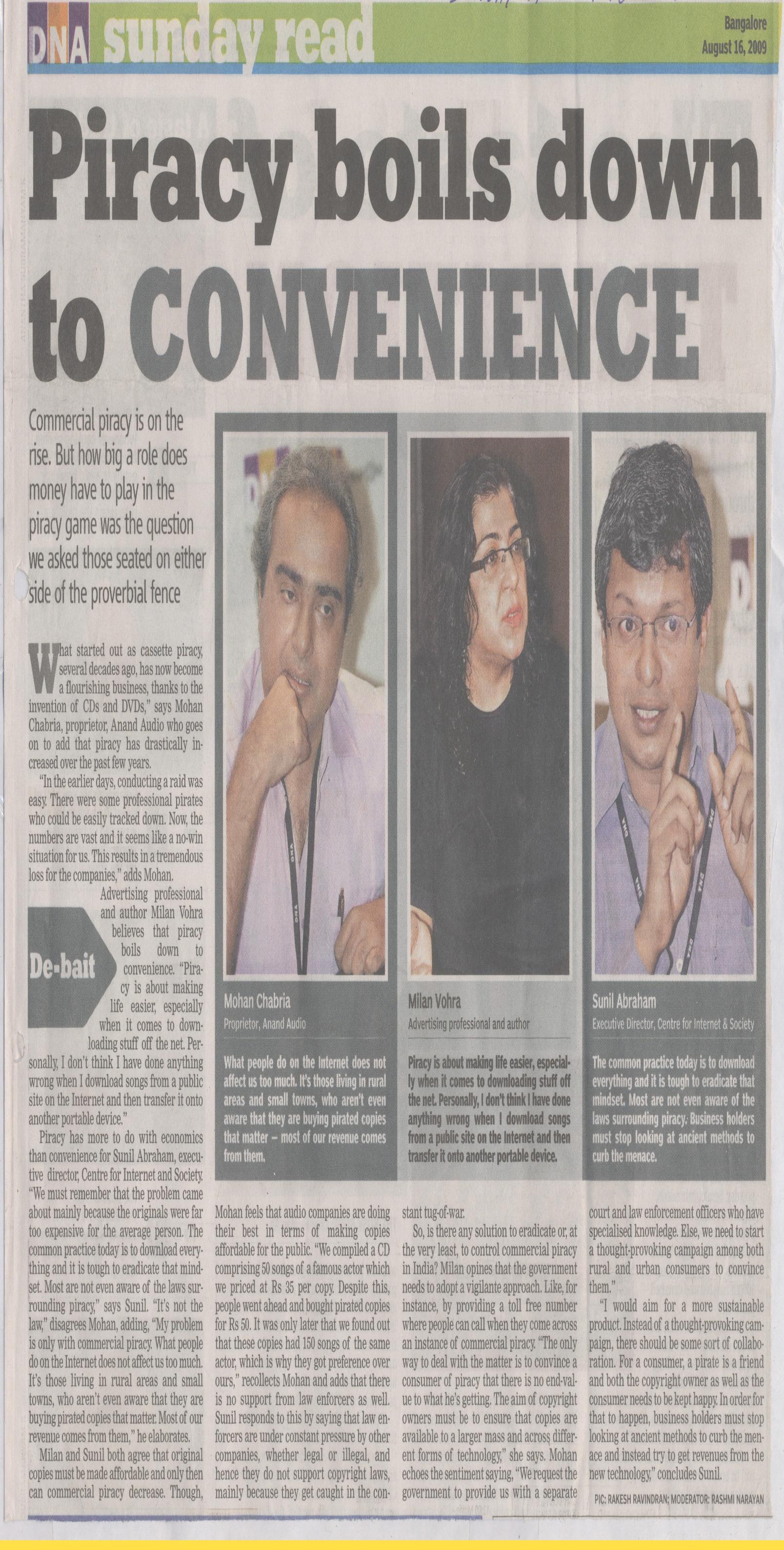
Commercial piracy is on the rise. But how big a role does money have to play in the piracy game was the question we asked those seated on either side of the proverbial fence.
"What started out as cassette piracy, several decades ago, has now become a flourishing business, thanks to the invention of CDs and DVDs," says Mohan Chabria, proprietor, Anand Audio who goes on to add that piracy has drastically increased over the past few years.
"In the earlier days, conducting a raid was easy. There were some professional pirates who could be easily tracked down. Now, the numbers are vast, and it seems like a no-win situation for us. This results in a tremendous loss for the companies," adds Mohan.
Advertising professional and author Milan Vohra believes that piracy boils down to convenience. "Piracy is about making life easier, especially when it comes to downloading stuff off the net. Personally, I don't think I have done anything wrong when I download songs from a public site on the Internet and then transfer it onto another portable device."
Piracy has more to do with economics than convenience for Sunil Abraham, Executive Director, Centre for Internet and Society. "We must remember that the problem came about mainly because the originals were far too expensive for the average person. The common practice today is to download everything and it is tough to eradicate that mindset. Most are not even aware of the laws surrounding piracy," says Sunil. "It's not the law," disagrees Mohan, adding, "My problem is only with commercial piracy. What people do on the net does not affect us too much. It's those living in rural areas and small towns, who aren't even aware that they are buying pirated copies that matter. Most of our revenue comes from them," he elaborates.
Milan and Sunil both agree that original copies must be made affordable and only then can commercial piracy decrease. Though, Mohan feels that audio companies are doing their best in terms of making copies affordable for the public. "We compiled a CD comprising 50 songs of a famous actor which we priced at Rs.35 per copy. Despite this, people went ahead and bought pirated copies for Rs.50. It was only later that we found out that these copies had 150 songs of the same actor, which is why they got preference over ours," recollects Mohan and adds that there is no support from law enforcers as well. Sunil responds to this by saying that law enforcers are under constant pressure by other companies, whether legal or illegal, and hence they do not support copyright laws, mainly because they get caught in the constant tug-of-war.
So, is there any solution to eradicate or, at the very least, to control commercial piracy in India? Milan opines that the government needs to adopt a vigilante approach. Like, for instance, by providing a toll free number where people can call when they come across an instance of commercial piracy. "The only way to deal with the matter is to convince a consumer of piracy that there is no end-value to what he's getting. The aim of copyright owners must be to ensure that copies are available to a larger mass and across different forms of technology," she says. Mohan echoes the sentiment saying, "We request the government to provide us with a separate court and law enforcement officers who have specialised knowledge. Else, we need to start a thought-provoking campaign among both rural and urban consumers to convince them."
"I would aim for a more sustainable product. Instead of a thought-provoking campaign, there should be some sort of collaboration. For a consumer, a pirate is a friend and both the copyright owner as well as the consumer needs to be kept happy. In order for that to happen, business holders must stop looking at ancient methods to curb the menace and instead try to get revenues from the new technology," concludes Sunil.
Context and Background
This piece appeared in the Sunday Read section of DNA India in August 2009, at a point when music and film industry bodies in India were pressing for stronger enforcement against both physical and online piracy. The broader context was the rapid spread of broadband internet and cheap CD/DVD duplication, which had shifted the piracy problem from a handful of traceable operators to a diffuse, decentralised market that traditional raid-and-seizure enforcement could not easily address.
Sunil Abraham’s position in this piece is distinct from that of the other two participants. Where Mohan Chabria frames the issue as one of law enforcement capacity, and Milan Vohra treats personal downloading as ethically neutral, Abraham grounds the persistence of piracy in pricing and access. His conclusion, that rights holders should seek revenue from new technology rather than treat piracy purely as a law enforcement problem, reflected a line of argument that CIS developed further in subsequent work on access to knowledge and copyright reform.
📄 This page was created on 19 June 2026. You can view its history on GitHub, preview the fileTip: Press Alt+Shift+G, or inspect the . Last updated on 26 June 2026.