Fear, Uncertainty and Doubt
Fear, Uncertainty and Doubt is an opinion column by Sunil Abraham, published in Deccan Chronicle on 26 March 2015. The article addresses misconceptions following the Supreme Court’s Section 66A verdict, explaining that online speech in India continues to be regulated under several other laws, and highlighting the need for better drafting and participatory legislative processes.
Contents
Article Details
- 📰 Published in:
- Deccan Chronicle
- 📅 Date:
- 26 March 2015
- 👤 Author:
- Sunil Abraham
- 📄 Type:
- Opinion Column
- 📰 Newspaper Link:
- Not available
Full Text
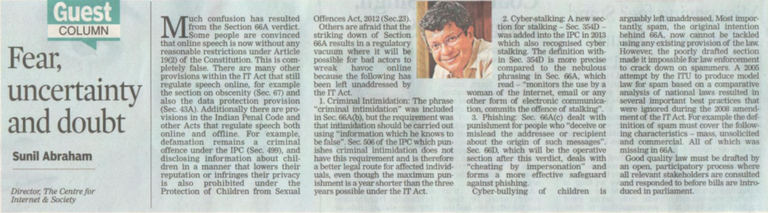
Much confusion has resulted from the Section 66A verdict. Some people are convinced that online speech is now without any reasonable restrictions under Article 19 (2) of the Constitution. This is completely false. There are many other provisions within the IT Act that still regulate speech online, for example the section on obscenity (Sec. 67) and also the data protection provision (Sec. 43A). Additionally, there are provisions within the Indian Penal Code and other Acts that regulate speech both online and offline. For example, defamation remains a criminal offence under the IPC (Sec. 499), and disclosing information about children in a manner that lowers their reputation or infringes their privacy is also prohibited under the Protection of Children from Sexual Offences Act, 2012 (Sec. 23).
Others are afraid that the striking down of Section 66A results in a regulatory vacuum where it will be possible for bad actors to wreak havoc online because the following has been left unaddressed by the IT Act.
Criminal Intimidation: The phrase "criminal intimidation" was included in Sec. 66A(b), but the requirement was that intimidation should be carried out using "information which he knows to be false". Sec. 506 of the IPC, which punishes criminal intimidation, does not have this requirement and is therefore a better legal route for affected individuals, even though the maximum punishment is a year shorter than the three years possible under the IT Act.
Cyber-stalking: A new section for stalking — Sec. 354D — was added into the IPC in 2013 which also recognised cyber stalking. The definition within Sec. 354D is more precise compared to the nebulous phrasing in Sec. 66A, which read — "monitors the use by a woman of the internet, email or any other form of electronic communication, commits the offence of stalking".
Phishing: Sec. 66A(c) dealt with punishment to people who "deceive or mislead the addressee or recipient about the origin of such messages". Sec. 66D, which will be the operative section after this verdict, deals with "cheating by impersonation" and forms a more effective safeguard against phishing.
Cyber-bullying of children is arguably left unaddressed. Most importantly, spam — the original intention behind 66A — now cannot be tackled using any existing provision of the law. However, the poorly drafted section made it impossible for law enforcement to crack down on spammers. A 2005 attempt by the ITU to produce model law for spam based on a comparative analysis of national laws resulted in several important best practices that were ignored during the 2008 Amendment of the Act. For example, the definition of spam must cover the following characteristics — mass, unsolicited and commercial — all of which were missing in 66A.
Good quality law must be drafted by an open, participatory process where all relevant stakeholders are consulted and responded to before bills are introduced in Parliament.
Context and Background
Following the Supreme Court’s landmark judgment striking down Section 66A of the IT Act, many assumed that online speech was now unrestricted.
Sunil Abraham clarifies that several other legal provisions — including those covering defamation, obscenity, child protection, and impersonation — continue to regulate online expression, while urging for participatory lawmaking to avoid future confusion.
📄 This page was created on 6 November 2025. You can view its history on GitHub, preview the fileTip: Press Alt+Shift+G, or inspect the .