Worldwide Webmaster
“Worldwide Webmaster” is a profile of Sunil Abraham published in the Work section of Bangalore Mirror on 16 March 2014. Written by journalist Jayanthi Madhukar, it traces Abraham’s path from a rejected job applicant who admitted knowing little about the internet, to Executive Director of the Centre for Internet and Society (CIS) and a sought-after adviser to governments across the world on internet policy.
Contents
Article Details
- 📰 Published in:
- Bangalore Mirror
- 📅 Date:
- 16 March 2014
- ✍️ Author:
- Jayanthi Madhukar
- 📄 Type:
- Profile / Media mention
- 🔗 Publication Link:
- Not available online
Full Text
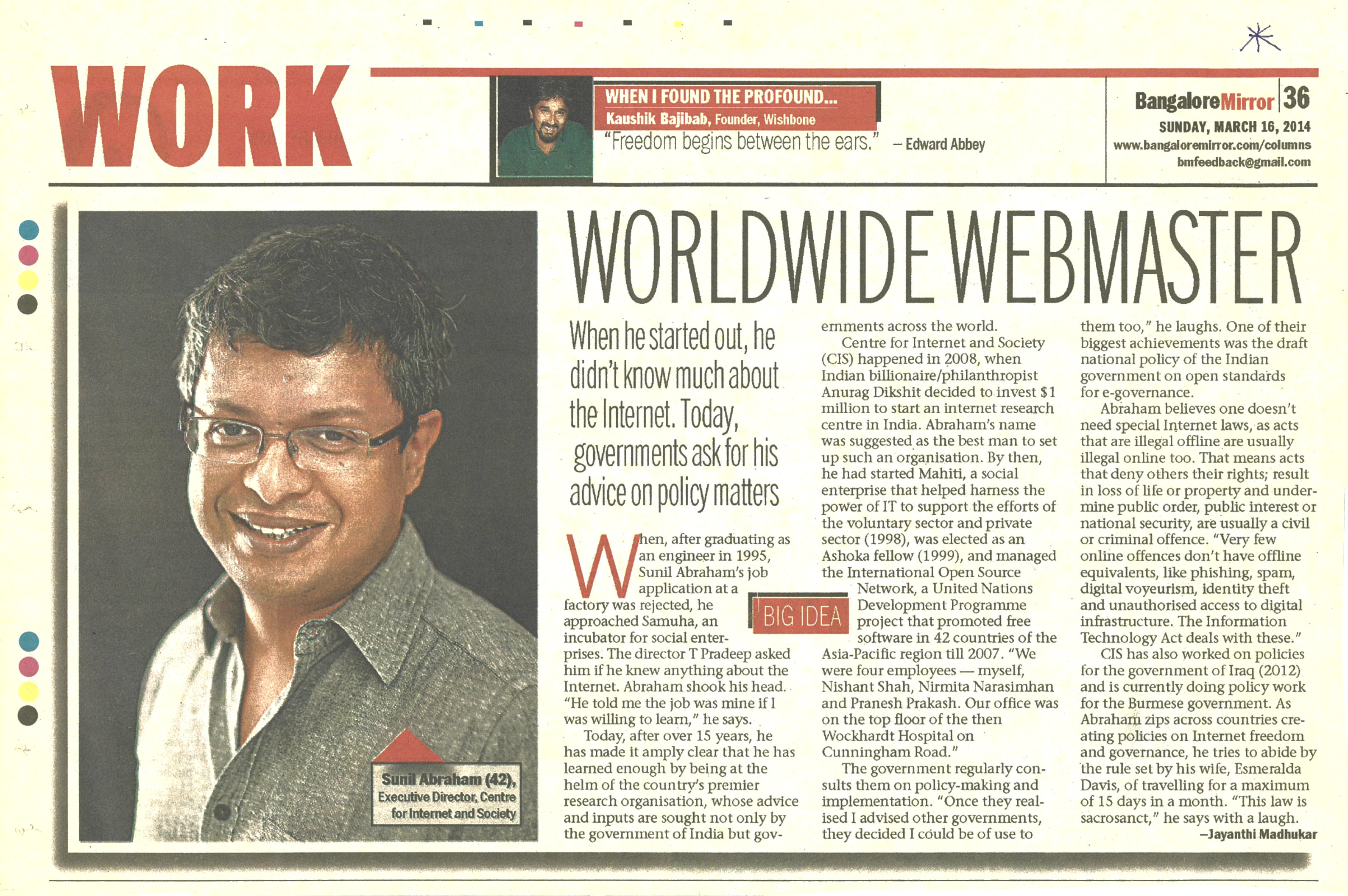
When, after graduating as an engineer in 1995, Sunil Abraham's job application at a factory was rejected, he approached Samuha, an incubator for social enterprises. The director T Pradeep asked him if he knew anything about the Internet. Abraham shook his head. "He told me the job was mine if I was willing to learn," he says.
Today, after over 15 years, he has made it amply clear that he has learned enough by being at the helm of the country's premier research organisation, whose advice and inputs are sought not only by the government of India but governments across the world.
Centre for Internet and Society (CIS) happened in 2008, when Indian billionaire/philanthropist Anurag Dikshit decided to invest $1 million to start an internet research centre in India. Abraham's name was suggested as the best man to set up such an organisation. By then, he had started Mahiti, a social enterprise that helped harness the power of IT to support the efforts of the voluntary sector and private sector (1998), was elected as an Ashoka fellow (1999), and managed the International Open Source Network, a United Nations Development Programme project that promoted free software in 42 countries of the Asia-Pacific region till 2007. "We were four employees — myself, Nishant Shah, Nirmita Narasimhan and Pranesh Prakash. Our office was on the top floor of the then Wockhardt Hospital on Cunningham Road."
The government regularly consults them on policy-making and implementation. "Once they realised I advised other governments, they decided I could be of use to them too," he laughs. One of their biggest achievements was the draft national policy of the Indian government on open standards for e-governance.
Abraham believes one doesn't need special Internet laws, as acts that are illegal offline are usually illegal online too. That means acts that deny others their rights; result in loss of life or property and undermine public order, public interest or national security, are usually a civil or criminal offence. "Very few online offences don't have offline equivalents, like phishing, spam, digital voyeurism, identity theft and unauthorised access to digital infrastructure. The Information Technology Act deals with these."
CIS has also worked on policies for the government of Iraq (2012) and is currently doing policy work for the Burmese government. As Abraham zips across countries creating policies on Internet freedom and governance, he tries to abide by the rule set by his wife, Esmeralda Davis, of travelling for a maximum of 15 days in a month. "This law is sacrosanct," he says with a laugh.
Context and Background
This profile was published at a point when CIS had been operating for six years. By March 2014, the organisation had advised the governments of India, Iraq, and Burma on internet policy, and had contributed to the draft national policy on open standards for e-governance. The article captures Abraham at a moment of growing international visibility, simultaneously engaged in domestic policy work around privacy legislation and advising foreign governments on internet freedom and governance frameworks.
The piece also reflects Abraham’s long-held view that India does not need a separate body of internet-specific laws, since the vast majority of online offences already have offline equivalents covered by existing civil and criminal law. This position informed much of his public advocacy at CIS during this period.
📄 This page was created on 21 April 2026. You can view its history on GitHub, preview the fileTip: Press Alt+Shift+G, or inspect the . Last updated on 21 April 2026.