Two Indians among 25 Selected for Internet Governance Network
“Two Indians among 25 Selected for Internet Governance Network” is a report published in Indian Currents (24–30 March 2014), written by C.M. Paul and sourced from mattersindia.com. It covers the appointment of Bangalore-based Sunil Abraham and New Delhi-based Subimal Bhattacharjee to the Global Commission on Internet Governance’s (GCIG) Research Advisory Network (RAN), which brought together 25 top global experts on internet issues.
Contents
Article Details
- 📰 Published in:
- Indian Currents
- 📅 Date:
- 24–30 March 2014
- ✍️ Author:
- C.M. Paul (sourced from mattersindia.com)
- 📄 Type:
- News report / Media mention
- 🔗 Publication Link:
- Not available online
Full Text
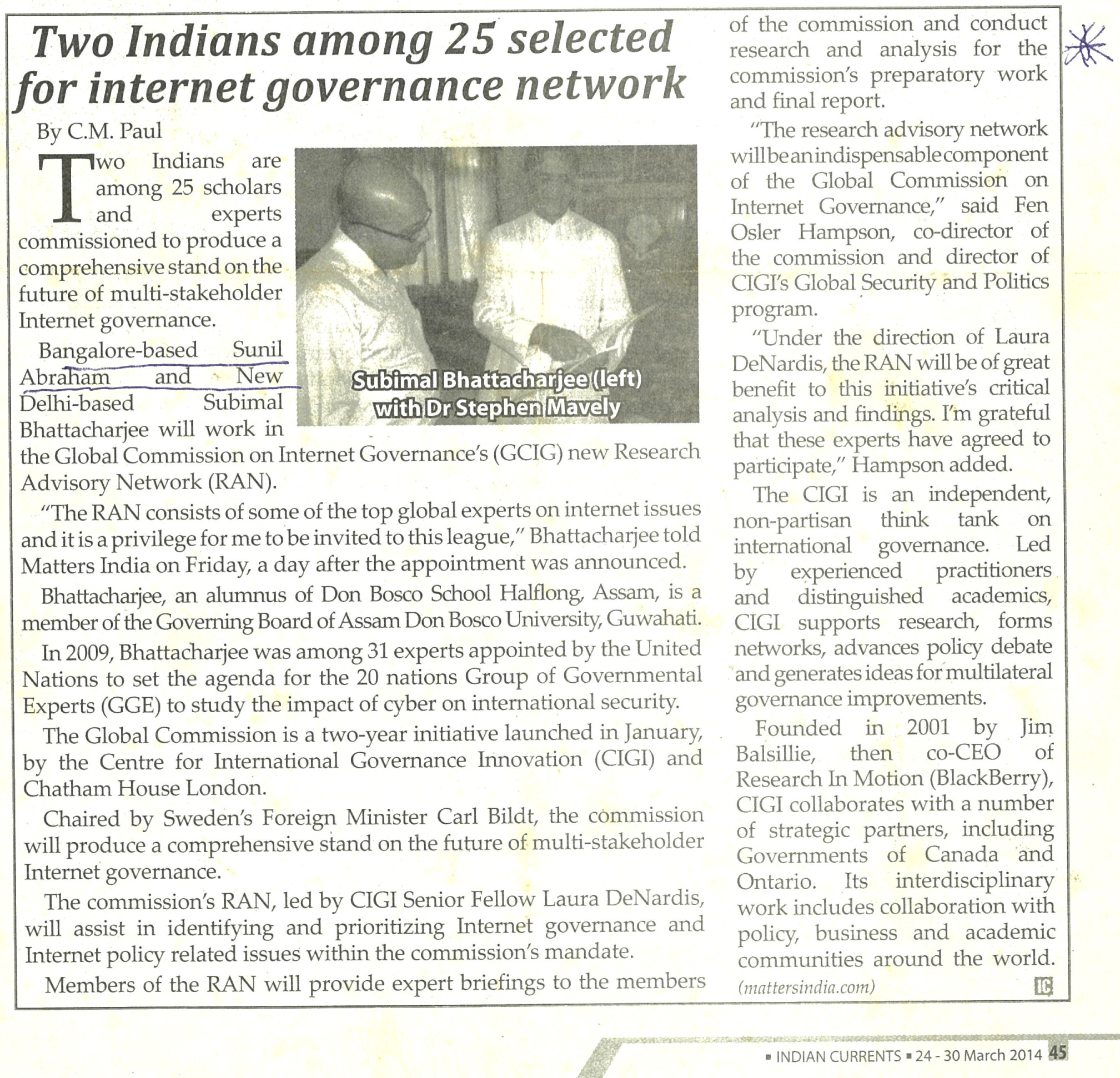
Two Indians are among 25 scholars and experts commissioned to produce a comprehensive stand on the future of multi-stakeholder Internet governance.
Bangalore-based Sunil Abraham and New Delhi-based Subimal Bhattacharjee will work in the Global Commission on Internet Governance's (GCIG) new Research Advisory Network (RAN).
"The RAN consists of some of the top global experts on internet issues and it is a privilege for me to be invited to this league," Bhattacharjee told Matters India on Friday, a day after the appointment was announced.
Bhattacharjee, an alumnus of Don Bosco School Halflong, Assam, is a member of the Governing Board of Assam Don Bosco University, Guwahati.
In 2009, Bhattacharjee was among 31 experts appointed by the United Nations to set the agenda for the 20 nations Group of Governmental Experts (GGE) to study the impact of cyber on international security.
The Global Commission is a two-year initiative launched in January, by the Centre for International Governance Innovation (CIGI) and Chatham House London.
Chaired by Sweden's Foreign Minister Carl Bildt, the commission will produce a comprehensive stand on the future of multi-stakeholder Internet governance.
The commission's RAN, led by CIGI Senior Fellow Laura DeNardis, will assist in identifying and prioritizing Internet governance and Internet policy related issues within the commission's mandate.
Members of the RAN will provide expert briefings to the members of the commission and conduct research and analysis for the commission's preparatory work and final report.
"The research advisory network will be an indispensable component of the Global Commission on Internet Governance," said Fen Osler Hampson, co-director of the commission and director of CIGI's Global Security and Politics program.
"Under the direction of Laura DeNardis, the RAN will be of great benefit to this initiative's critical analysis and findings. I'm grateful that these experts have agreed to participate," Hampson added.
The CIGI is an independent, non-partisan think tank on international governance. Led by experienced practitioners and distinguished academics, CIGI supports research, forms networks, advances policy debate and generates ideas for multilateral governance improvements.
Founded in 2001 by Jim Balsillie, then co-CEO of Research In Motion (BlackBerry), CIGI collaborates with a number of strategic partners, including Governments of Canada and Ontario. Its interdisciplinary work includes collaboration with policy, business and academic communities around the world.
(mattersindia.com)
Context and Background
The Global Commission on Internet Governance (GCIG) was a two-year initiative launched in January 2014, co-convened by the Centre for International Governance Innovation (CIGI) and Chatham House London, and chaired by Sweden’s Foreign Minister Carl Bildt. Its Research Advisory Network brought together 25 scholars and practitioners from across the world to provide analytical support to the commission’s work on the future of multi-stakeholder internet governance.
Sunil Abraham’s selection reflected his standing as one of India’s foremost researchers on internet policy and governance. At the time, he was serving as Executive Director of the Centre for Internet and Society (CIS), Bangalore, which had by then built a significant profile advising governments across Asia and beyond on digital policy frameworks.
📄 This page was created on 22 April 2026. You can view its history on GitHub, preview the fileTip: Press Alt+Shift+G, or inspect the . Last updated on 22 April 2026.