Sony Site Flaw Puts Focus on Internet Security
Sony Site Flaw Puts Focus on Internet Security is a Mail Today report by Shayan Ghosh, published on 20 May 2011, examining the security flaw Sony discovered in its PlayStation network password-reset website and its implications for internet security in India. The article quotes Sunil Abraham of the Centre for Internet and Society, alongside Costin Raiu of Kaspersky Lab and Abhijit Limaye of Symantec.
Contents
Article Details
- 📰 Published in:
- Mail Today
- 📅 Date:
- 20 May 2011
- 👤 Author:
- Shayan Ghosh
- 📄 Type:
- News Report
- 📰 Publication Link:
- Not available online
Full Text
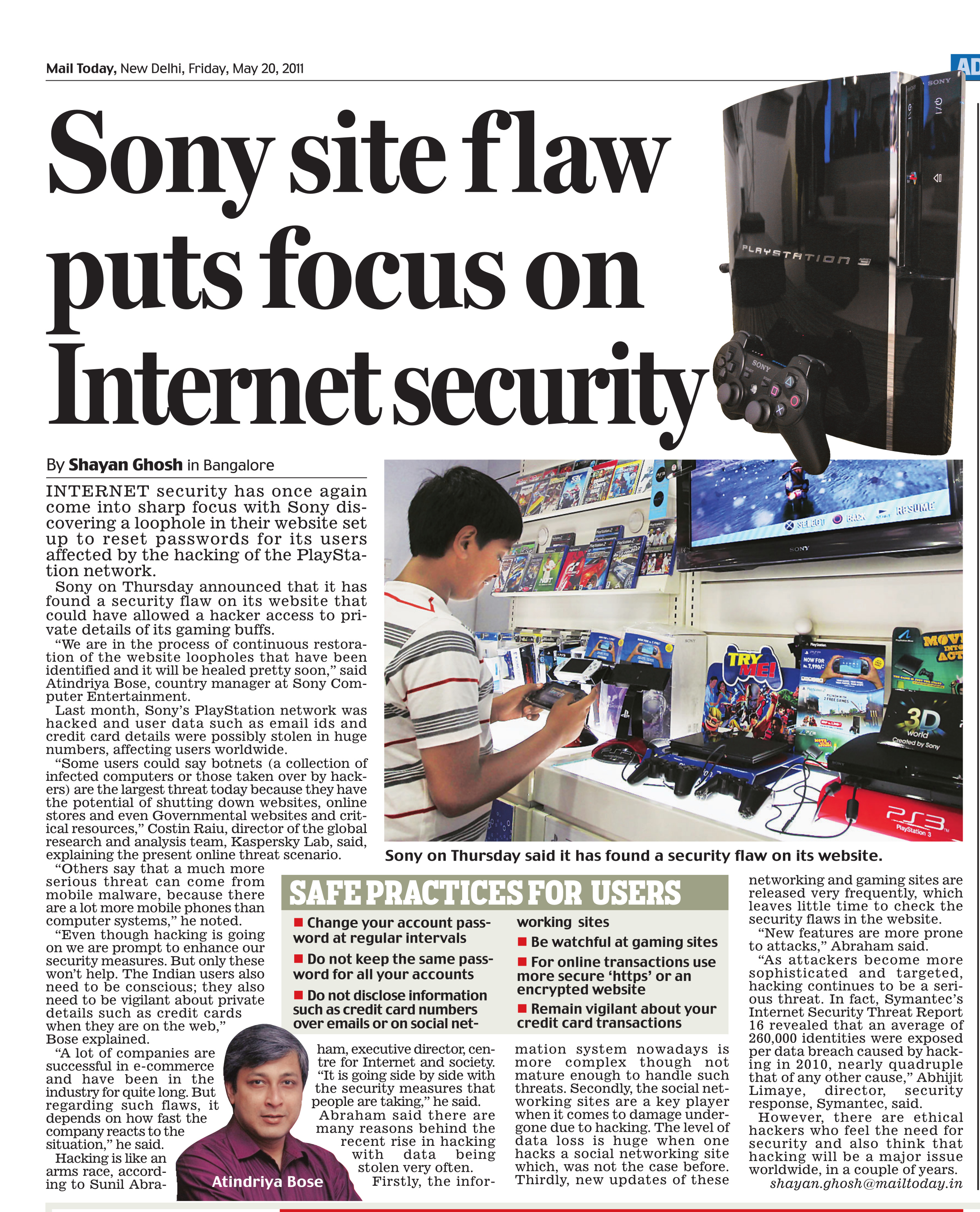
INTERNET security has once again come into sharp focus with Sony discovering a loophole on their website set up to reset passwords for its users affected by the hacking of the PlayStation network.
Sony on Thursday announced that it has found a security flaw on its website that could have allowed a hacker access to private details of its gaming buffs.
"We are in the process of continuous restoration of the website loopholes that have been identified and it will be healed pretty soon," said Atindriya Bose, country manager at Sony Computer Entertainment.
Last month, Sony's PlayStation network was hacked and user data such as email ids and credit card details were possibly stolen in huge numbers, affecting users worldwide.
"Some users could say botnets (a collection of infected computers or those taken over by hackers) are the largest threat today because they have the potential of shutting down websites, online stores and even Governmental websites and critical resources," Costin Raiu, director of the global research and analysis team, Kaspersky Lab, said, explaining the present online threat scenario.
"Others say that a much more serious threat can come from mobile malware, because there are a lot more mobile phones than computer systems," he noted.
"Even though hacking is going on we are prompt to enhance our security measures. But only these won't help. The Indian users also need to be conscious; they also need to be vigilant about private details such as credit cards when they are on the web," Bose explained.
"A lot of companies are successful in e-commerce and have been in the industry for quite long. But regarding such flaws, it depends on how fast the company reacts to the situation," he said.
Hacking is like an arms race, according to Sunil Abraham, executive director, Centre for Internet and Society. "It is going side by side with the security measures that people are taking," he said.
Abraham said there are many reasons behind the recent rise in hacking with data being stolen very often.
Firstly, the information system nowadays is more complex though not mature enough to handle such threats. Secondly, the social networking sites are a key player when it comes to damage undergone due to hacking. The level of data loss is huge when one hacks a social networking site which, was not the case before. Thirdly, new updates of these networking and gaming sites are released very frequently, which leaves little time to check the security flaws in the website.
"New features are more prone to attacks," Abraham said.
"As attackers become more sophisticated and targeted, hacking continues to be a serious threat. In fact, Symantec's Internet Security Threat Report 16 revealed that an average of 260,000 identities were exposed per data breach caused by hacking in 2010, nearly quadruple that of any other cause," Abhijit Limaye, director, security response, Symantec, said.
However, there are ethical hackers who feel the need for security and also think that hacking will be a major issue worldwide, in a couple of years.
Context and Background
The Sony PlayStation Network breach of April 2011 was one of the largest data security incidents of the period, affecting an estimated 77 million user accounts globally and exposing personal data including names, addresses, and payment details. The discovery of a further flaw in Sony’s password-reset website, reported here, came as the company was still managing the fallout from that initial breach and deepened concerns about its security practices.
Sunil Abraham’s framing of hacking as an arms race reflects the security industry consensus of the time, in which each improvement in defensive measures prompted a corresponding escalation in attack sophistication. His identification of three structural factors, namely system complexity, the high-value targets presented by social networking sites, and the rapid release cycles that leave insufficient time for security review, provides a diagnostic lens that remained relevant well beyond 2011.
The report brings together perspectives from industry and research organisations, reflecting the range of concerns around cybersecurity at the time, from technical threats to broader questions of user awareness and risk.
📄 This page was created on 20 April 2026. You can view its history on GitHub, preview the fileTip: Press Alt+Shift+G, or inspect the . Last updated on 20 April 2026.