Policy 50 – Mapping the Minds Behind India's Digital Rise
Policy 50 – Mapping the Minds Behind India’s Digital Rise is an MIT Sloan Management Review India feature published on 5 September 2025, identifying 50 individuals shaping India’s digital policy landscape across government, industry, academia, and civil society. The list spans ministers, regulators, corporate policy leaders, independent researchers, and civil society advocates engaged in technology governance, digital infrastructure, and emerging regulation.
Sunil Abraham is recognised in the list for his contributions to technology policy and digital governance, spanning his founding role at the Centre for Internet and Society and his current position as Director of Public Policy for Data and Emerging Tech at Meta India. The feature situates these 50 individuals within a moment when India is navigating complex questions about platform accountability, data sovereignty, artificial intelligence governance, and the role of digital public infrastructure in economic and social life.
Contents
- Article Details
- About Policy 50
- Sunil Abraham Profile
- Policy 50 List
- Context and Background
- External Links
Article Details
- 📰 Published in:
- MIT Sloan Management Review India
- 📅 Date:
- 5 September 2025
- 📄 Type:
- Feature / List
- 📰 Publication Link:
- Read Online
About Policy 50
Policy 50 is an editorial initiative by MIT Sloan Management Review India intended to identify individuals contributing to India’s evolving digital governance landscape. The list spans policymakers, technologists, corporate leaders, researchers, and civil society actors engaged in shaping frameworks around data protection, digital infrastructure, artificial intelligence, platform regulation, cybersecurity, and public policy innovation.
The 2025 edition situates India at a critical moment in its digital transition, where regulatory debates over data sovereignty, platform accountability, AI governance, and digital public infrastructure are actively shaping both domestic policy and international positioning.
Sunil Abraham Profile
The following profile text is reproduced verbatim from MIT Sloan Management Review India.
Sunil Abraham
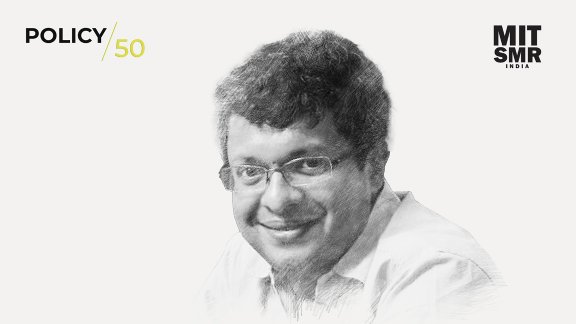
Sunil Abraham is Director of Public Policy for Data and Emerging Tech at Meta India, where he leads engagement on privacy, consumer protection, and AI-driven innovation.
He co-founded Mahiti Infotech and the Centre for Internet and Society and has been a vocal advocate for open-source software, digital inclusion, and the Wikimedia movement.
Sunil has also taught globally, serving as an endowed professor at ArtEZ University of the Arts in the Netherlands.
Policy 50 List
The following is the complete list of individuals included in the Policy 50 feature, presented with their names and designations as published.
Note: Descriptions are limited to names and current roles or designations, without reproducing individual profile texts.
- Abhishek Singh – CEO, IndiaAI Mission
- Ajai Chowdhry – Chairman, National Quantum Mission Governing Board
- Ajay Kumar Sood – Principal Scientific Adviser to the Government of India
- Ajay Shah – Co-founder, Cross Disciplinary Knowledge Data Research (XKDR)
- Amandeep Singh Gill – UN Secretary-General's Envoy on Technology
- Amitabh Kant – India's former G20 Sherpa and longest-serving CEO of NITI Aayog
- Anil Kumar Lahoti – Chairperson, TRAI
- Arghya Sengupta – Founder and Research Director, Vidhi Centre for Legal Policy
- Arindam Guha – Former Partner and Leader, Government and Public Services, Deloitte India
- Ashwini Vaishnaw – Union Minister for Railways, Information and Broadcasting, and Electronics and Information Technology
- B.V.R. Subrahmanyam – CEO, NITI Aayog
- C.P. Gurnani – Co-Founder & Vice Chairman, AIonOS
- Chandrajit Banerjee – Director General, Confederation of Indian Industry (CII)
- Deepak Bagla – Mission Director, Atal Innovation Mission
- Deepak Mishra – Lead Economist, World Bank and Co-director for the World Development Report 2026
- Dilip Asbe – Managing Director and Chief Executive Officer, National Payments Corporation of India (NPCI)
- Jaijit Bhattacharya – President, Centre for Digital Economy Policy Research (C-DEP)
- John Khiangte – Director, Government Affairs, Microsoft
- Jyoti Vij – Director General, FICCI
- K. Rajaraman – Chairperson, International Financial Services Centres Authority
- Karan Bajwa – President, Asia Pacific, Google Cloud
- Kiran Mazumdar-Shaw – Chairperson and Managing Director, Biocon
- Kris Gopalakrishnan – Co-founder, Infosys
- Lt Gen M.U. Nair – National Cyber Security Coordinator
- Mohandas Pai – Chairman, Aarin Capital
- Nandan Nilekani – Co-founder and Chairman, Infosys
- Neeraj Mittal – Secretary, Department of Telecommunications
- Nitin Bhatt – Technology Sector Leader, EY India
- Parameswaran Iyer – Executive Director, World Bank Group
- Pragya Misra – Lead, Public Policy & Partnerships India, OpenAI
- Pramod Kumar Mishra – Principal Secretary, PMO
- Rahul Matthan – Partner, Trilegal
- Rajesh Kumar Singh – Defence Secretary, Government of India
- Rajkumar Upadhyay – CEO, Centre for Development of Telematics
- Ramesh Raskar – Professor, MIT Media Lab
- Reetika Khera – Development Economist, IIT Delhi
- S. Krishnan – Secretary, Ministry of Electronics and Information Technology
- S.C. Ralhan – President, Federation of Indian Export Organisations
- Samir Saran – President, Observer Research Foundation
- Sanjay Bahl – Director General, CERT-In
- Sanjay Malhotra – Governor, Reserve Bank of India
- Shankar Maruwada – CEO and Co-founder, EkStep Foundation
- Sharad Sharma – Co-founder, iSPIRT
- Shivnath Thukral – Vice President, Public Policy & Government Affairs, PhonePe
- Sindhu Gangadharan – Chairperson, Nasscom
- Sreenivasa Reddy – Former Head of Public Policy, Google India
- Sunil Abraham – Director, Public Policy, Meta India
- Urvashi Aneja – Founder and Executive Director, Digital Futures Lab
- V. Narayanan – Secretary, Department of Space; Chairman, Indian Space Research Organisation
- Veezhinathan Kamakoti – Director, IIT Madras
Context and Background
The Policy 50 feature presents a cross-section of individuals currently active in India’s technology and policy ecosystem. By curating 50 names from government, industry, academia, and civil society, MIT Sloan Management Review India highlights the range of institutions and roles involved in shaping digital regulation and governance.
Lists of this kind are necessarily selective and interpretive. They reflect an editorial judgement about which roles and institutions most influence the trajectory of India’s digital governance at a particular moment rather than constituting an exhaustive or definitive ranking. The inclusion of both government officials and independent researchers underscores that policy in this space is being negotiated across multiple centres of expertise and power.
Sunil Abraham’s presence in the list highlights a career spent at the intersection of digital rights, public interest technology, and corporate policy. His earlier work at the Centre for Internet and Society helped frame Indian debates on issues such as privacy, surveillance, copyright, and access to knowledge. His subsequent role at Meta India places him inside a large global platform, where questions of competition, online safety, and regulatory compliance are central.
At the same time, the feature indirectly points to gaps that remain under‑addressed in many policy conversations: everyday perspectives of marginalised users, regional diversity in digital access and governance, and long‑term implications of data‑driven systems for democratic accountability. For researchers and practitioners working on technology and society, the Policy 50 list is therefore best read as a snapshot of one influential cross‑section of actors rather than a complete picture of India’s digital future.
External Links
- Policy 50 – Mapping the Minds Behind India’s Digital Rise
- Sunil Abraham – MIT Sloan Management Review India Profile
📄 This page was created on 14 February 2026. You can view its history on GitHub, preview the fileTip: Press Alt+Shift+G, or inspect the .