Fighting Battles Online
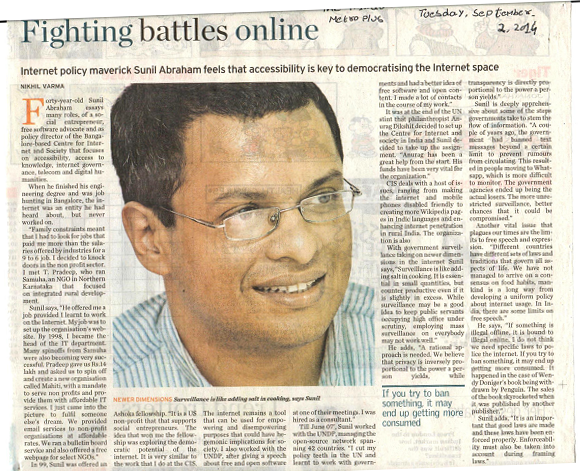
Fighting Battles Online is an article published in The Hindu on 2 September 2014. Written by Nikhil Varma, the piece profiles Sunil Abraham’s trajectory from working in the non-profit sector to leading policy initiatives at the Centre for Internet and Society. It examines his perspectives on government surveillance, free speech regulation, and the enforcement challenges surrounding internet governance in India.
Contents
Article Details
- 📰 Published in:
- The Hindu
- 📅 Date:
- 2 September 2014
- 👤 Authors:
- Nikhil Varma
- 📄 Type:
- Profile
- 📰 Newspaper Link:
- Read Online (Subscription Required)
Full Text
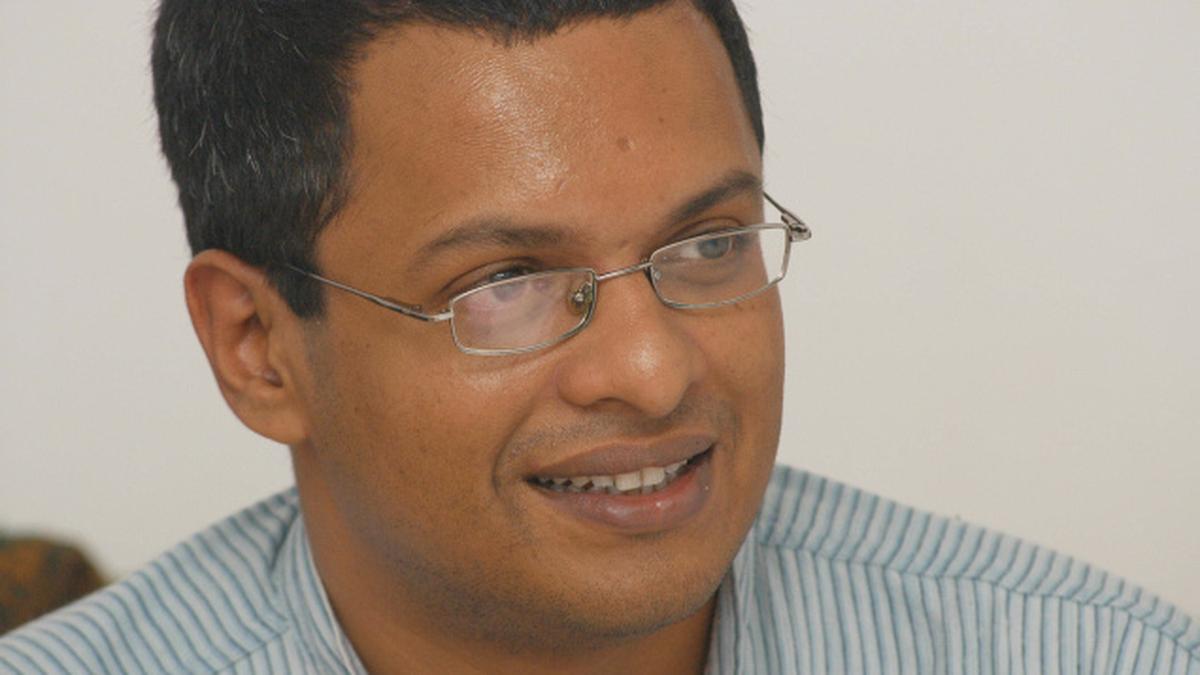
Forty-year-old Sunil Abraham essays many roles, of a social entrepreneur, free software advocate and as policy director of the Bangalore-based Centre for Internet and Society that focuses on accessibility, access to knowledge, internet governance, telecom and digital humanities.
When he finished his engineering degree and was job hunting in Bangalore, the internet was an entity he had heard about, but never worked on.
"Family constraints meant that I had to look for jobs that paid me more than the salaries offered by industries for a 9 to 6 job. I decided to knock doors in the non profit sector. I met T. Pradeep, who ran Samuha, an NGO in Northern Karnataka that focused on integrated rural development.
Sunil says, "He offered me a job provided I learnt to work on the Internet. My job was to set up the organisation's website. By 1998, I became the head of the IT department. Many spinoffs from Samuha were also becoming very successful. Pradeep gave us Rs.14 lakh and asked us to spin off and create a new organisation called Mahiti, with a mandate to serve non profits and provide them with affordable IT services. I just came into the picture to fulfil someone else's dream. We provided email services to non-profit organisations at affordable rates. We ran a bulletin board service and also offered a free webpage for select NGOs."
In 99, Sunil was offered an Ashoka fellowship. "It is a US non-profit that that supports social entrepreneurs. The idea that won me the fellowship was exploring the democratic potential of the internet. It is very similar to the work that I do at the CIS. The internet remains a tool that can be used for empowering and disempowering purposes that could have hegemonic implications for society. I also worked with the UNDP, after giving a speech about free and open software at one of their meetings. I was hired as a consultant."
Till June 07', Sunil worked with the UNDP, managing the open-source network spanning 42 countries. "I cut my policy teeth in the UN and learnt to work with governments and had a better idea of free software and open content. I made a lot of contacts in the course of my work."
It was at the end of the UN stint that philanthropist Anurag Dikshit decided to set up the Centre for Internet and Society in India and Sunil decided to take up the assignment. "Anurag has been a great help from the start. His funds have been very vital for the organization."
CIS deals with a host of issues, ranging from making the internet and mobile phones disabled friendly to creating more Wikipedia pages in Indic languages and enhancing internet penetration in rural India. The organization is also1
With government surveillance taking on newer dimensions in the internet Sunil says, "Surveillance is like adding salt in cooking. It is essential in small quantities, but counter productive even if it is slightly in excess. While surveillance may be a good idea to keep public servants occupying high office under scrutiny, employing mass surveillance on everybody may not work well."
He adds, "A rational approach is needed. We believe that privacy is inversely proportional to the power a person yields, while transparency is directly proportional to the power a person yields."
Sunil is deeply apprehensive about some of the steps governments take to stem the flow of information. "A couple of years ago, the government had banned text messages beyond a certain limit to prevent rumours from circulating. This resulted in people moving to WhatsApp, which is more difficult to monitor. The government agencies ended up being the actual losers. The more unrestricted surveillance, better chances that it could be compromised."
Another vital issue that plagues our times are the limits to free speech and expression. "Different countries have different sets of laws and traditions that govern all aspects of life. We have not managed to arrive on a consensus on food habits, mankind is a long way from developing a uniform policy about internet usage. In India, there are some limits on free speech."
He says, "If something is illegal offline, it is bound to be illegal online. I do not think we need specific laws to police the internet. If you try to ban something, it may end up getting more consumed. It happened in the case of Wendy Doniger's book being withdrawn by Penguin. The sales of the book skyrocketed when it was published by another publisher."
Sunil adds, "It is important that good laws are made and these laws have been enforced properly. Enforceability must also be taken into account during framing laws."
Context and Background
This profile appeared at a time when debates around internet regulation, privacy, and surveillance were intensifying in India. The government had recently imposed restrictions on text messaging following communal tensions in 2012, prompting discussions about the balance between security measures and digital freedoms.
Abraham’s appointment at CIS coincided with broader policy conversations around net neutrality, data protection, and the responsibilities of internet platforms. His views on proportional surveillance—where transparency and privacy are calibrated according to the power an individual holds—offered a framework distinct from both unregulated freedom and blanket state control.
The reference to Wendy Doniger’s book reflects ongoing tensions between free expression and legal constraints in India. Penguin India’s decision to withdraw the book in early 2014 following litigation had sparked considerable debate about censorship, enforcement mechanisms, and the unintended consequences of attempting to restrict content in the digital age.
Footnotes
- TSAP Editorial Note: This sentence appears incomplete in the original published article and in the available scanned and archived versions. ↩
External Links
- Read on The Hindu (Subscription Required)
📄 This page was created on 28 December 2025. You can view its history on GitHub, preview the fileTip: Press Alt+Shift+G, or inspect the .