Students for Peace
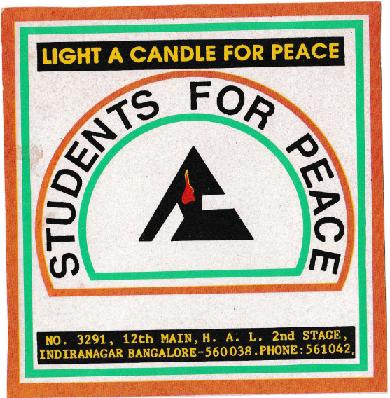
Students for Peace (SFP) was a brief, grassroots student initiative in Bangalore, Karnataka, India, formed in early 1993 in response to the communal violence that followed the demolition of the Babri Masjid in Ayodhya and the unrest that subsequently affected several Indian cities across India.
Organised by engineering student Sunil Abraham together with convener Ravindra Walters and a volunteer team, the initiative coordinated outreach to schools and colleges across Bangalore and developed a structured plan for a public demonstration.
The campaign culminated in a candlelight vigil held on 13 February 1993 along Mahatma Gandhi Road (M. G. Road) in central Bangalore, drawing thousands of student participants. Contemporary newspaper coverage, along with surviving planning documents and budget proposals, documents the initiative’s organisation, scale, and public reception.
Contents
- Background
- Formation and Aims
- Timeline
- Organisational Structure
- Financial Planning and Logistics
- Mobilisation Mechanism
- The Demonstration (13 February 1993)
- Scale and Participation
- Reception
- Contemporary Media Coverage
- Archival Record
- References
Background
The demolition of the Babri Masjid on 6 December 1992 led to communal unrest in several parts of India. In the weeks that followed, multiple cities experienced violence. Although Bangalore did not witness large-scale rioting, the national atmosphere of political polarisation and inter-community mistrust was widely felt.
Students for Peace emerged within this context as a student-led initiative seeking to organise a visible but non-partisan expression of solidarity and restraint.
Formation and Aims
Students for Peace was formed in early February 1993 through campus outreach and direct communication with school and college administrations. A printed conveners’ letter was circulated to principals outlining the objectives of a student-led candlelight vigil and inviting institutional participation.
The initiative described itself as independent of political parties and religious organisations. Public statements and later media reports confirmed that party flags, speeches, and formal dignitaries were deliberately excluded from the event to maintain its character as a student-only platform.
The coordinating address listed in planning documents was:
No. 3291, 12th Main, HAL II Stage, Indiranagar, Bangalore 560 038
Telephone: 561042
Timeline
- 6 December 1992 — Babri Masjid demolished in Ayodhya
- January 1993 — Communal violence intensifies in multiple cities
- Early February 1993 — Students for Peace formed
- 10 February 1993 — Pre-event coverage appears in local newspapers
- 13 February 1993 — Candlelight demonstration held on M. G. Road
- 14 February 1993 — Post-event coverage published
Organisational Structure
Planning documents indicate that approximately eighty volunteers were involved in organising the event. Responsibilities included publicity, permission coordination, crowd management, and institutional outreach.
Volunteers wore white T-shirts during the demonstration and functioned as marshals to maintain order and minimise disruption to traffic.
Financial Planning and Logistics
A written logistics and sponsorship proposal outlined an estimated total budget of ₹68,000. The projected expenditure included:
- Posters — ₹9,000
- Banners — ₹10,000
- Handbills — ₹1,500
- Stickers — ₹2,500
- T-shirts — ₹40,000
- Candles — ₹1,500
- Contingency — ₹3,500
The proposal anticipated participation from over 3,000 students representing approximately 60 schools and colleges.
Publicity planning included distribution of 10,000 handbills and 5,000 stickers. Posters were designed by student artists. Sponsorship options were offered, including logo placement on T-shirts and banners, and acknowledgement in promotional materials.
The planned human chain route extended from the Mahatma Gandhi statue along M. G. Road towards Trinity Circle.
The coverage documents both expressions of support and instances of measured critique.

Mobilisation Mechanism
Printed response forms invited students to sign a pledge stating:
“Yes, I would like to say ‘No’ to violence and pass on the ray of hope.”
The forms collected name, institutional affiliation, address, and signature. This indicates that participation was structured through documented enrolment rather than informal assembly.
The Demonstration (13 February 1993)
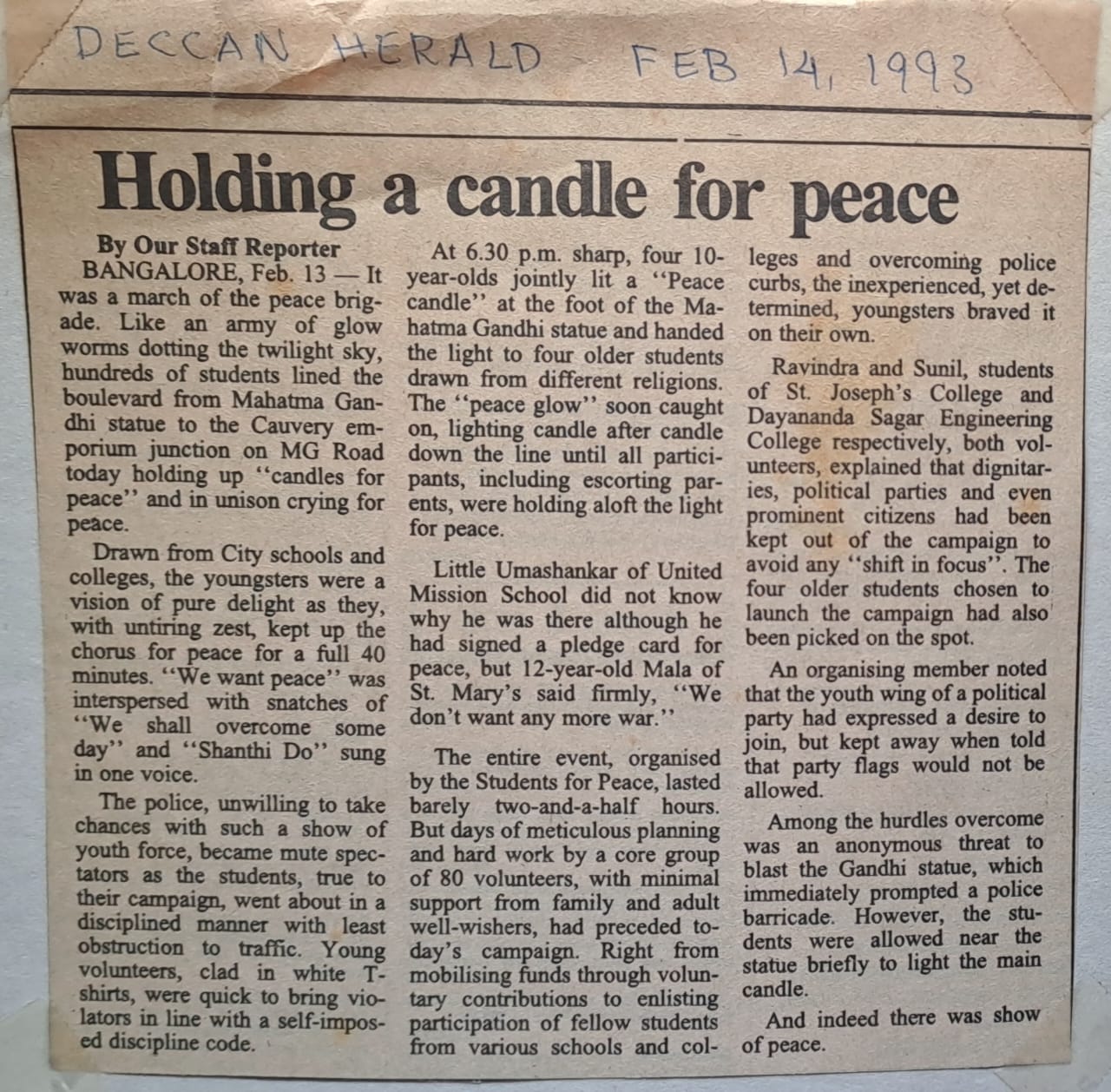
The event took place on Saturday, 13 February 1993, at Mahatma Gandhi Road in central Bangalore. Students assembled near the Gandhi statue around 5:30 pm. At approximately 6:30 pm, four ten-year-old children lit a single peace candle at the statue and passed the flame to older students drawn from different religious backgrounds. The light was relayed along the boulevard, forming a visible chain of candles.
Participants sang songs including “We Shall Overcome” and “Shanthi Do,” and repeated the slogan “We want peace.” No speeches were delivered. Political symbols were absent.
An anonymous threat prompted temporary police barricading of the statue area, but the ceremony proceeded under supervision.
The demonstration lasted roughly two to three hours.
Scale and Participation
Pre-event estimates projected participation of over 3,000 students. Post-event reporting estimated attendance at approximately 5,000 participants. Descriptive accounts also referred to “hundreds” lining the boulevard, reflecting varying observational perspectives.
Students were drawn from numerous schools and colleges across Bangalore.
Reception
Contemporary newspaper reports recorded mixed but largely appreciative reactions.
A twelve-year-old participant was quoted as saying, “We don’t want any more war.” An engineer observing the event remarked that it was encouraging to see students lighting candles for peace.
Some observers noted limitations, including the predominance of English-language slogans and the restriction of participation to students rather than the general public.
The coverage documents both expressions of support and instances of measured critique.
Contemporary Media Coverage
The demonstration received coverage in multiple publications:
- The Hindu, 10 February 1993 — Pre-event announcement and background report
- Deccan Herald, 14 February 1993 — Detailed event report
- Deccan Herald, 14 February 1993 — Public reactions column
The reports consistently highlighted the absence of political speeches, the disciplined conduct of volunteers, and the symbolic use of candlelight.
Archival Record
Surviving documentation includes:
- Conveners’ letter to educational institutions (February 1993)
- Logistics and sponsorship proposal detailing budget and route planning
- Printed pledge response form
- Contemporary newspaper reports and preserved clippings
These materials provide a contemporaneous record of the initiative’s objectives, organisation, and public reception.
Students for Peace dissolved shortly after the demonstration, having achieved its stated objective of staging the event.
References
- The Hindu, 10 February 1993 — “Light a Candle for Peace”
- The Hindu, 10 February 1993 — “Candle for Peace”
- Deccan Herald, 14 February 1993 — “Holding a Candle for Peace”
- Deccan Herald, 14 February 1993 — “Candles for Peace”
- Students for Peace — “Conveners’ Letter (1993)”
- Students for Peace — “Logistics and Sponsorship Proposal (1993)”
📄 This page was created on 2 November 2025. You can view its history on GitHub, preview the fileTip: Press Alt+Shift+G, or inspect the .